In many companies, freelancers have long been part of the extended workforce – flexible, highly specialized, ready to go quickly. But with this agility, the legal risk rises as well, in particular that of bogus self-employment. And that can get expensive – in the form of back payments, criminal proceedings, and considerable reputational damage.

The problem: many companies rely on manual and outdated checklists or the personal responsibility of the business units. But legally secure processes? Nowhere to be found.
Why is the topic so complex? – Everyone does it a little differently
A key reason for the uncertainty in dealing with bogus self-employment is that there is no clear legal definition or unambiguous case law. Every case is decided individually – depending on numerous factors such as project content, integration into the organization, or the nature of communication. This gray area makes it particularly difficult for business units and procurement to establish certainty early on.
Bogus self-employment does not arise from bad intent, but from a lack of knowledge, differing interpretations – and missing standards.
A few classic causes from the interviews:
Timing of the check: The legal check often happens only after the candidate has been selected – which at first glance seems too late, but in practice is often necessary. Because a well-founded bogus-self-employment assessment requires precise knowledge of the freelancer's individual setup: does he have a limited company? Does he employ staff? Does he work for other clients in parallel? This information is usually only available after the preselection – and should then be checked in a targeted way. At the same time, a legally secure basis must already be created at the very beginning – that is, with the project description. It should be clearly formulated, checked for the freelancer being bound by instructions, and tailored to the deployment context, in order to withstand later risks during the bogus-self-employment check.
Business units without guidance: Many hiring managers don't even know what is allowed – and what is not. Keeping track of labor law, social security, and the tax office isn't exactly everyday business either. The challenge already begins with the wording of the project description: if it is formulated unclearly, too bound by instructions, or too close to the internal day-to-day business, the risk rises that the engagement is classified as bogus self-employment during an audit.
"The topic is partly not even consciously ignored – it is simply not known." - Olaf Haehnel
Trust instead of structure: Many companies rely on external service providers, in the hope: "They'll do it right." But even there, a standardized process or transparent check is often missing. In practice it turns out: the checks by these service providers are frequently superficial – for example a single standard questionnaire that is applied equally to all roles. That may formally suggest certainty, but often falls short for more complex profiles.
Unclear role requirements: What still passes for a "PMO" can be legally problematic for a "Prompt Engineer." Roles differ not only in their professional characteristics but also in their legal risk – which makes blanket assessments nearly impossible.
How to avoid expensive mistakes – 3 concrete approaches
1. Bogus self-employment cannot be assessed with a traffic light
The risk of bogus self-employment cannot simply be categorized with a traffic-light logic into "red," "yellow," or "green." Every case must be considered in a highly individual and nuanced way – a "yellow" can mean a low or a very high risk depending on the context. Whoever relies on simple color codes quickly lulls themselves into a false sense of security.
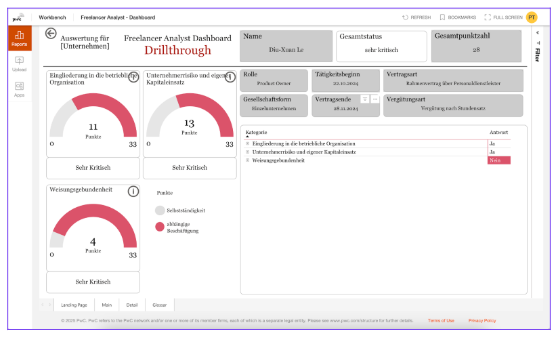
2. Role-based risk assessment
Standard questionnaires along the lines of "one size fits all" are not enough for a legally secure assessment. Instead, specifically developed question catalogs are needed for certain roles, which query the actual working conditions and the context in a differentiated way.
FRATCH works closely with PwC on this. Together they regularly create and update questionnaires based on current case law – depending on role, industry, and deployment context. The result: a role-based, dynamic risk assessment that is not only documented but also stands up to potential audits.
Dedicated questionnaires are recommended for the following roles:
- General questionnaire
- Product Owner
- Scrum Master
- Change Manager
- Software Developer
- Software Tester
- DevOps Engineer
- IT Project Manager
- Network and System Administrator
- Back office assistant
- Customer service agent
- Cyber & IT security consultants
- Management consultants
3. An automated process instead of gut feeling
Instead of Excel and Word: use structured, automated workflows. An ideal process (e.g. via guided buying) checks directly at the briefing stage, automatically steers the fitting contract types, and informs procurement, HR, and the business unit in sync.
"Once a guided buying system is introduced, there is no more excuse to use other channels." - Christoph Quick-Timmerhaus