Even in 2025, many freelancer procurements still run like it's the early 2000s: by email, PDF, Excel, and gut feeling. Sounds old school? It is. While other processes have long been fully automated, many procurement departments are still stuck in copy-paste mode when it comes to freelancer sourcing.
"You work at the edge of your capacity because so much is not automated." – Daniel Bruchatz
The manual effort not only slows down the pace, it also eats up capacity. On top of that it complicates compliance and poses a data protection risk. Sending sensitive project descriptions, CVs, and budget information unencrypted by email is not just inefficient – it also carries a significant GDPR risk. No wonder frustration is rising in the business units: the processes are slow, opaque, or simply no longer up to date.

Why is so much still done by hand here? – The usual suspects
- No end-to-end process In practice, business units often report their demand informally by email. Existing systems (e.g. SAP) are bypassed or, because of their complexity, only brought in very late.
"The main channel is email … we could use SAP, but email is still the main route." – Sabrina Lüdtke
"Nah, it's purely, it's by emails and then by phone and so on, quite classic." - Filippos Siakavaras
- Missing tools for tendering & selection Many companies have no vendor management system (VMS) or no platform for standardized tendering. Instead: mailing lists and PDF quotes that are compared manually.
"13 pages, hundreds of line items – I have to put that into Excel manually." – Daniel Burchardt
Lack of integration & media breaks Even where tools exist, processes are often not free of media breaks. Excel lists, email communication, and manual approvals are the order of the day.
Individual workarounds instead of standard processes Everyone does it a little differently. Managers save prompts, forwardings, and workflows locally – central standards or a uniform process are almost completely missing.
No central reporting Maverick buying or budget overruns often only surface once the money has already been spent. Transparency is largely missing – and when it is created, then only through a great deal of manual effort.
"I developed a database that tracks maverick buying. Laborious, but we finally see the lost savings." – Sabrina Lüdtke
From handcraft to high performance – 3 ways to automated freelancer procurement
For companies that want more than manual coordination, an AI-based guided buying process is a good fit – specifically: freelancer and interim sourcing with an AI agent that can be integrated directly into existing work tools such as Microsoft Teams or Slack. This process can be implemented in two ways:
1. DIY variant
Building an individual automation with tools such as ChatGPT, Zapier, Google Sheets, or Make. Advantage: maximum flexibility.
2. Out-of-the-box solution
Using specialized solutions such as FRATCH, which are ready to use immediately and bring along all the necessary interfaces, automations, and rule sets – from demand capture to compliance-secured engagement.
A third option is implementation via an external service partner:
3. Implementation via an MSP (Managed Service Provider)
Here an external service provider takes over the steering and handling of the entire freelancer procurement. The advantage: relief for procurement. The disadvantage: the introduction is usually complex, expensive, and generally only pays off from a high volume onward. In addition, MSPs often do not increase the degree of automation, because their workflows are based on outdated standard tools. That relieves procurement, but delivers hardly any added value for the business units. Besides a base fee borne by the company, the costs amount to roughly 1.5% - 3% of the freelancer revenue. That is technically borne by the intermediaries, but they usually pass it back onto the freelancer's daily rate.
But before we dive into the tool discussion, let's take a look at the ideal-typical workflow. This process has already been successfully introduced at over 10 companies, validated by 30 more – and is of course welcome to be developed further (feedback welcome 😉):
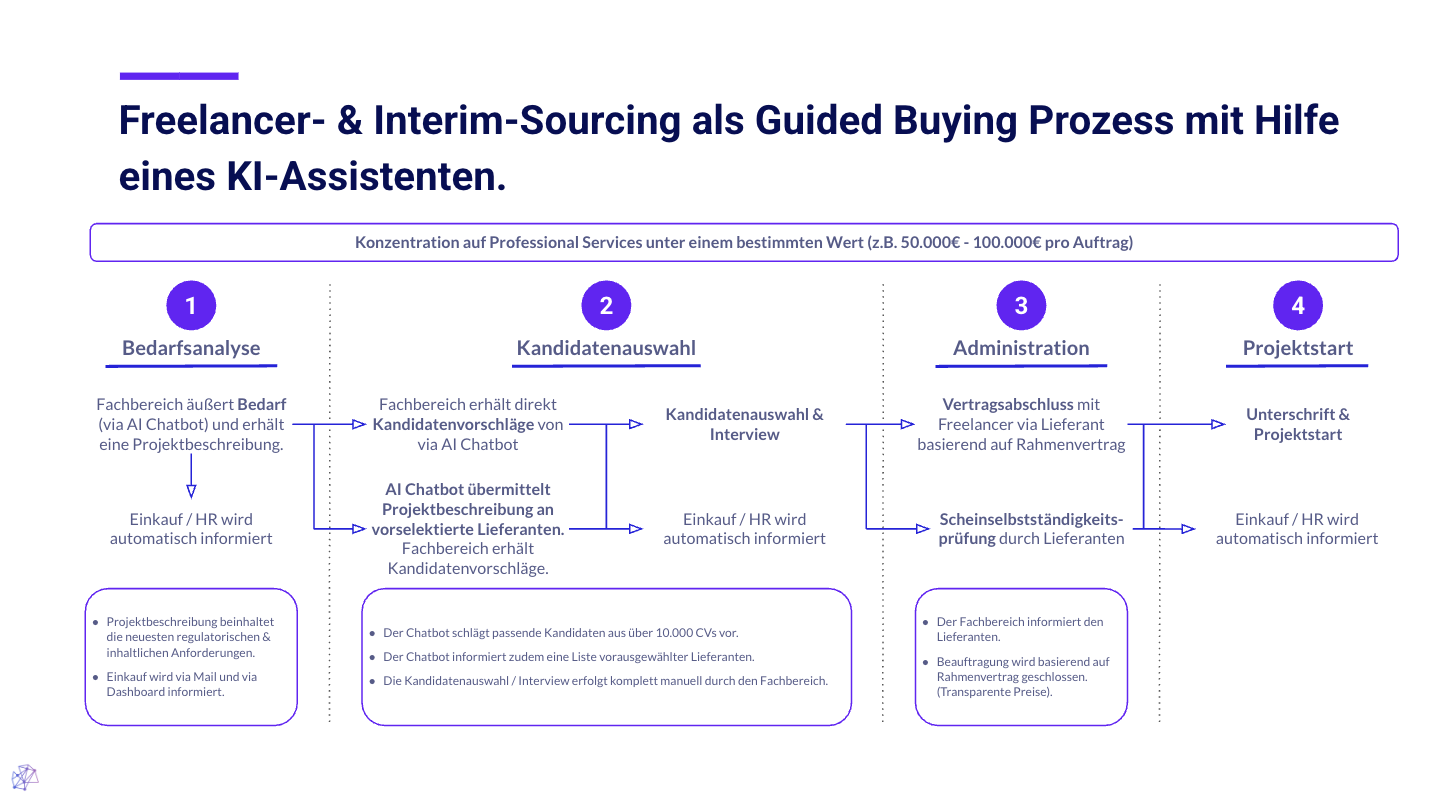
How it works with the out-of-the-box solution
Requirement: The business unit formulates its demand directly in the chat with the AI agent – the agent automatically generates a rule-compliant and bogus-self-employment-compliant project description from it. Procurement and HR are informed simultaneously and receive all information in a clear dashboard.
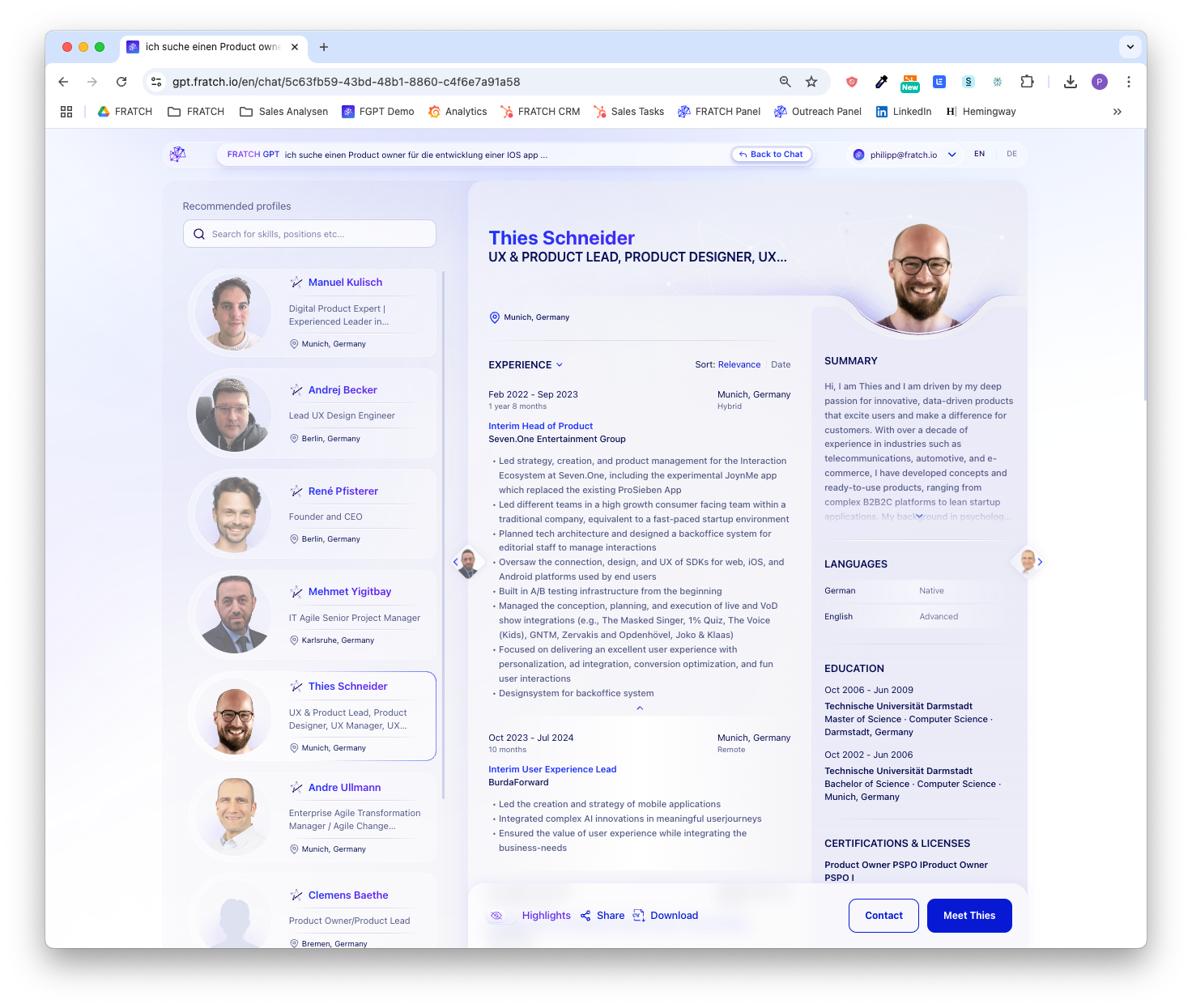
Candidate search: The AI agent matches the request against more than 10,000 profiles and delivers fitting suggestions – either directly from the database of the AI agent / intermediary and via a defined list of preferred service providers. Here too, procurement is informed automatically:
Administration: The contract is concluded on the basis of a framework agreement with the supplier (e.g. directly with FRATCH or your preferred supplier), including an automatic bogus-self-employment check. Here too, price and margin are transparently governed and can be viewed at any time in the dashboard.
Project start: After selection and contract conclusion the project starts – procurement and HR are automatically informed across all steps, or can grant the final approval.
What this delivers:
- No more manual formulation of requirements
- No follow-up ping-pong with intermediaries
- Transparency over price, margin, and supplier
- Compliance & GDPR: project descriptions and CVs are processed systematically and securely
- Business units get help immediately – procurement stays in control
How it works with the DIY variant
Requirement: The business unit enters project information – such as time frame, required skills, or target daily rate – into a simple online form (e.g. Google Forms or Microsoft Forms). A connected ChatGPT template (via Zapier or Make) automatically creates a rule-compliant project description from it – including notes on bogus self-employment. This is automatically transmitted to procurement and HR (e.g. via email or Slack) and stored in a central database (e.g. Google Sheets).
Tool example: ChatGPT (API) + Google Forms + Zapier for automatic text creation and routing
Candidate search: Based on the project description, the request is automatically sent to a defined supplier distribution list – e.g. via Lemlist or an Outlook-Zapier flow. Optionally, external platforms (e.g. LinkedIn talent pools) can also be addressed automatically. Incoming profiles are stored in a structured way in Google Sheets or Airtable
Tool example: Zapier or Make for the multi-channel request, Google Sheets or Airtable as the collection point
Administration: The final selection is confirmed by the business unit in a selection form. A two-stage approval process is mapped via a tool such as Jotform Approvals, Trello, Monday, or Google Forms with email forwarding. Contract documents are created manually or semi-automatically via pre-built templates (e.g. DocuSign or Google Docs with a Zapier trigger). An optional manual bogus-self-employment check (e.g. via a checklist form) can be included.
Tool example: Google Docs templates + DocuSign + manual review or checklist
Project start: Once approval is granted, the engagement is forwarded to accounting and HR. Project start, supplier contact details, contract terms, and daily rate are documented on a central freelancer tracking board – e.g. with Notion, Airtable, or Excel.
DIY or out-of-the-box? – A comparison
The DIY variant is flexible, individually adaptable, and technically appealing – especially for organizations with in-house automation skills. But: the setup costs time, and so does the maintaining. And let's be honest: most buyers already have too little of that. The FRATCH GPT solution, on the other hand, is ready to use immediately, integrates seamlessly into existing tools such as Microsoft Teams, and is free to use. Existing framework-agreement suppliers can also continue to be connected – without additional integration costs.