Freelancers have long been a fixed part of modern project teams – but when it comes to the question of what they really cost, the guessing game often begins. Business units and buyers do see the daily rate in the system – but how it is composed remains unclear in many cases. Who gets how much? How high is the margin? And is the price even in line with the market?
"I only know the sales price, but not what the freelancer gets."
This lack of transparency not only makes solid negotiations harder – it also undermines the trust between procurement, business unit, intermediary, and freelancer. Because whoever does not understand the price doubts its fairness or has diverging expectations.

Why procurement starts to brood – the invisible price drivers in detail
Why is the topic of price so opaque? In our conversations, four main reasons came up again and again:
Margin secrecy: Many service providers only name the final price. How much of it actually reaches the freelancer remains unclear. One reason: many employees on the intermediary side are incentivized via the margin. The higher the markup on the daily rate, the higher the bonus – transparency? Not in their own interest.
"The margins are actually not known to us, or only rudimentarily. [...] We see the daily rates that we have."
Prices like stock quotes: Daily rates fluctuate merrily – the same freelancer is €1,100 today and offered at €800 six months later; supply and demand set the price in real time. A FRATCH data analysis shows: some freelancers who still asked for €1,100 in 2023 were at €800 in 2024 – a price drop of around 27%. But it can go back up just as quickly – and whoever isn't flexible then loses out on top talent.
"We had negotiated a great contract – with a minimal margin. And suddenly nothing came anymore. The recruiters simply had no more interest in offering us anything, because their bonus was tied to the margin. I could pat myself on the back for the tough negotiation – but in the end I got nothing out of it. And neither did the company." - Sven Baudisch
Every role a one-off: Whether Senior UX Lead or Prompt Engineer – every freelancer profile is unique. Standardization? Difficult. Especially since the market is changing rapidly: new roles emerge constantly, old ones disappear. That makes long-term pricing guidelines a challenge.
Missing benchmarks: Without a central data basis, every price negotiation remains a gut decision. Whoever has no internal comparison values can hardly judge whether an offer is fair.
"You really have to look at how prices have changed over the last few years. It is simply difficult right now, especially in the services area." - Sabrina Lüdtke
Straight talk on costs – 4 measures for real price transparency
1. Open book price policy
Work with partners who disclose what the freelancer costs and what margin is added – firmly anchored in the framework agreement. If the intermediary then also provides a detailed overview, procurement has an overview of all purchase and sales prices at all times. And what this can mean in monetary terms is shown by the following example.
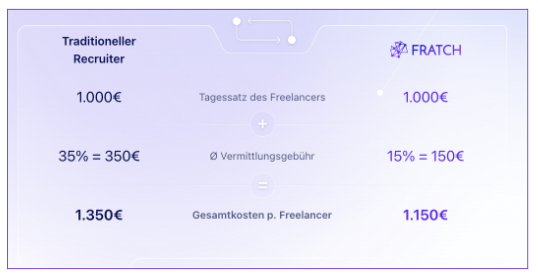
Advantages
- Maximum transparency for procurement and business unit
- Building trust between all parties (freelancer / business unit / procurement)
- Clear cost basis for negotiations
Disadvantages
- Only works with partners who live openness
- Possibly price increases if market prices rise
2. Your own benchmarking
For every engagement, record: role, daily rate, level, intermediary, region, and skills. Whether Excel, Airtable, or a BI tool – the main thing is that you build knowledge systematically. Tip: work with a traffic-light logic or price intervals for quick assessment. Your service provider may also be able to provide you with a regular price overview.
Advantages
- Well-founded comparability of future offers
- Internal transparency and negotiating confidence
Disadvantages
- Initial effort
- Continuous maintenance required
3. Rate cards
Define realistic price ranges for standard roles – differentiated by seniority level and region. Important: as guidance, not as dogma. For specialist roles such as a SAP GTS Developer, these models usually fall short.
Advantages
- Faster assessment when demand arises
- Consistent framework conditions
Disadvantages
- Risk of over-bureaucratization
- Becomes outdated quickly when the market changes
- Quality suffers under rigid specifications
- Risky for niche roles with individual prices
- Frustration for freelancers when they discover the true margins
- Works well for standard roles – but hardly for niche profiles such as a SAP GTS Developer
4. Actively monitor market trends
Use studies, platform data, or the exchange with other buyers to develop a realistic sense of prices.
A particularly hands-on example comes from Arnold Pritschet:
"Every year we do an analysis of the current price developments of the different rate-card roles. These serve as a negotiating lever." - Arnold Pritschet
As data sources, his team uses price indices from the Federal Statistical Office, which are published quarterly and annually:
"For every engagement we track which seniority was engaged at which daily rate." - Arnold Pritschet
From this a well-founded, internal comparison basis emerges, with which new offers can be classified and evaluated much better – and which also lends itself wonderfully to an informal benchmark chat at the next industry event.
Advantages
- Realistic orientation for negotiations
- Objectifiable data basis
Disadvantages
- Market transparency often patchy or subject to a fee
- Comparability difficult or too imprecise for complex role profiles
- High effort to review data regularly and keep it up to date