


Linux Experts in Germany
for secure infrastructure, cloud systems and reliable delivery, matched in minutes with AIHire experts who manage Linux servers, automate deployments with Ansible and Docker, and build resilient cloud or embedded environments. FRATCH connects you with vetted, available freelancers through fast, precise AI matching.

Meet FRATCH Experts in Germany, who have recently used Linux
Alwin G.

Last position:
IT Interim Manager & AI Strategist
- Founder of CheironX: AI-supported GRC management (ISO 27001, BSI IT-Grundschutz, TISAX, DORA)
- Strategic focus on Agentic AI and GenAI for modern IT Governance, Risk & Compliance Management
- IT interim management and strategic consulting
Klaus K.

Last position:
HCL Notes Banking Support, Domino Administration / Migration / Operations at Atruvia / HCL International
Description of duties “Atruvia / HCL International” Role: HCL Notes Banking Support, Domino Administration / Migration / Operations Operations, administration and technical support of the HCL Notes/Domino environment in the Atruvia banking environment on behalf of HCL. As part of an international support team, the focus was on second- and third-level support as well as the processing, management and monitoring of SLA tickets in categories 1, 2 and 3. Duties included the technical analysis and resolution of incidents in the Notes/Domino environment, system administration, and the development and modification of Lotus Notes /Domino applications and LotusScript agents when a programming solution was required. Another focus was ticket dispatching: analysing and assessing incoming tickets, assigning them to the responsible departments and specialist teams, and subsequently coordinating and tracking processing within the agreed SLA periods. There was also direct communication and coordination with subject-matter experts, departments and end customers of the connected banks. In particular, when language or technical communication problems arose within the international support team, German-language customer communication was handled and mediation between customers and technical specialists was provided. Objective Ensuring stable and reliable operation of the HCL Notes/Domino landscape in the Atruvia banking environment and the timely processing of business-critical support cases in line with the agreed Service Level Agreements. Incidents were to be analysed as early as possible and either resolved directly through administrative measures or suitable LotusScript/Notes solutions, or forwarded specifically to the responsible specialist teams. As of: 25.09.2026 (Version 2.10 LITE) including project times Page: 3 of 32 SPO-SOFT EDV Beratung, Dipl.-Ing. Klaus Kano, Tel.: +494532-2767682, Mail: [email], [link] At the same time, qualified preliminary analysis and targeted ticket dispatching were intended to ensure that every ticket reached the technically and professionally responsible department immediately and that unnecessary transfers, processing times and associated costs were reduced. Result Operational Notes/Domino support for the banks served was reliably ensured throughout the entire project period. SLA-relevant tickets were systematically analysed, prioritised, assigned to the responsible departments and tracked through to resolution. Some incidents were resolved directly through administration, technical error analysis and the development of suitable LotusScript agents and modifications to Notes/Domino applications. By directing tickets specifically to the relevant expert and specialist teams, incorrect assignments and unnecessary processing loops were reduced and compliance with the agreed SLA times was supported. Direct communication with the banks and mediation between German-speaking end customers and the international support team also contributed to efficient problem resolution and high customer satisfaction.
Silvia B.

Last position:
Business Consultant - Product Management Banking at Aareal Bank AG
- Focus on optimizing and further developing the internal customer EBICS application
- Functional and technical consulting for Aareal First Financial Solutions AG on EBICS standard products and applications in the areas of operations and further development, as well as project-related communication with external development partners and the product manufacturer to implement the corresponding technical optimizations
- As the functional coordinator, providing advice on content-related and regulatory requirements as well as technical prerequisites and requirements, and bringing these together at the functional level
- Consulting on the use of EBICS formats
- Reviewing the current EBICS standard for optimization and further development potential
- Analyzing the current state to identify development potential and deriving appropriate recommendations for action while considering regulatory requirements
- Conducting EBICS tests throughout the project
- Functional responsibility for requirements management and, in this context, recording and documenting requirements for such tests
- Designing a functional and sustainable test management system
- Conducting and evaluating tests
- Consulting on sustainable quality assurance and audits
- Project language: German and English
- Tools/Methods: MS Project, MS Office, MS Visio, TestRail, Confluence, Jira, Business Logics Bankkrecher, Business Logics Test Data Generator, Business Logics Banking Tool, Business Logics Test System, DBEAVER, Squirrel, Unix Virtual Machines, WinSCP, Kitty, Putty, various Aareal Bank products, Online Banking Portal, Aareal Sign, core banking system, SAP Blue Eagle, SAP RE-FX, Aareon Wodis Sigma, Haufe Real Estate Wowinex, GAP Group Immotion, UTS Karthago, SAP IS-U/Waste, SIV kVASy, various EBICS clients
Patrick L.

Last position:
Senior GenAI Fullstack Developer at SBH (Schulbau Hamburg)
Remote freelance role focused on Agentic AI strategy, secure application patterns, and reusable agentic workflows for a government agency.
- Development and implementation of an open-source Agentic AI strategy for a government agency, with a focus on GDPR, security, and self-hosted solutions
- Development of reusable agentic workflows and business applications that enable non-technical employees to solve business problems independently
- Implementation of nine business applications with Single Sign-On (SSO) and Azure PostgreSQL integration on Hetzner Linux servers
Techstack: Python, Streamlit, Anthropic SDK (Claude), Azure, Linux, PostgreSQL, MS SQL, Angular
Matthias S.

Last position:
Overall Project Coordinator at Bundeswehr Informatik (BWI GmbH)
- PMO Lead Security Clearance 2 (SÜ2) verified
- Reporting to the GMN sub-program management
- System maintenance 25+
- Functional management and coordination of the Jira setup
- Preparation of decision papers (e.g. project planning, governance model, communication plans, controlling models, roles and responsibilities matrices)
- Development of program-wide knowledge management using Confluence, creation of Jira concept
- Development of an access concept for all project tools
- Analysis of existing processes, identification of improvement potential, and design of solutions to increase efficiency and effectiveness
- Development of a concept for introducing automation approaches into existing tools
- Creation of intranet articles for project marketing
- Responsible for project governance through reporting and resource planning in the sub-program
- Agile development of the project methodology
- Gathering customer requirements (Requirements Engineering)
- Preparation and support of contract negotiations (7-year term, 500+ million budget)
Harold T.

Last position:
CPU Watcher — Cloud-Native Monitoring Application at SEUYTEL
- Planned and developed a CPU monitoring application for monitoring system performance and resource utilization.
- Designed and implemented a Spring Boot backend providing a REST API for processing and exposing monitoring data.
- Developed the React frontend for presenting monitoring information in a clear and user-friendly interface.
- Integrated PostgreSQL for persistent storage and management of application data.
- Containerized the application and its services using Docker Compose.
- Automated infrastructure provisioning and deployment using Terraform on AWS.
- Structured the application as a modern, maintainable system using REST-based communication between frontend and backend.
- Designed and developed a secure, scalable CPU monitoring architecture (cpu-watcher) with a dedicated collector application that streams monitoring data to the backend, reducing direct exposure of system resources.
- Designed a secure cloud infrastructure with the database isolated within a private network and OIDC-based authentication.
- Implemented Infrastructure as Code with Terraform and integrated version-controlled CI/CD pipelines to automate testing, infrastructure changes, and application deployments.
- Designed and implemented the frontend delivery architecture using AWS CloudFront.
Stack: Spring Boot · React · PostgreSQL · REST API · Docker Compose · Terraform · AWS
Markus B.

Last position:
Consultant, Technical Project Manager at Lanxess
- Project: ESU Windows and SQL Server Consolidation / Configuration Management in ServiceNow
- Prepared an as-is analysis of all servers worldwide
- Prepared an as-is analysis of all SQL servers worldwide
- Conducted requirements analyses for SQL and server migrations
- Coordinated requirements with partners for migrations to Hyper-V (on-premises) or Azure Cloud
- Facilitated regular status meetings (Jour Fixe)
- Developed roadmaps and solution models for server migrations
- Set up test scenarios
- Facilitated workshops for the rollout of a global admin team
- Designed data models (CMDB) in ServiceNow
- Led workshops for the CMDB data model
- Developed solution models for the CMDB
- Created end-to-end configuration documentation and work instructions for the CMDB
- Prepared reports for license management
- Defined KPIs for data quality in ServiceNow
- Created a service catalog
- Facilitated workshops to define service requests
- Acted as interface between requirements analysis and the ServiceNow development team
- Systems used: Windows 7, Windows 10, Microsoft Office 365/2010, Windows Server 20xx, SQL Server 20xx, SharePoint, Azure Cloud, Hyper-V, ServiceNow, various tools
Reza N.

Last position:
Senior IT-Security Expert at Teambank AG
- Completed the integration of log sources into Microsoft Sentinel, including GCP workloads – centralized consolidation of all security-relevant events from Azure and GCP environments for complete end-to-end telemetry and comprehensive compliance evidence
- Developed custom rules and use cases based on the GFG Use-Case Library and the MITRE ATT&CK Matrix to cover company-specific threats and GFG-relevant scenarios with precise, mapped detection rules
- Tuned detection rules to minimize false positives, optimized detection thresholds, and modeled exceptions – enabling the SOC to work with relevant, prioritized alerts while reducing Mean Time to Detect/Respond
- Built SOAR capabilities in Sentinel by developing playbooks to automate recurring response processes such as containment, user and host isolation, and ticketing – shorter response times and 24/7 scalability
- Designed and built a log transformation solution to normalize and enrich incoming raw logs (GeoIP, CMDB, threat intelligence) and convert them into a consistent schema for high-performance KQL queries, use case logic, and correlations
- Managed Azure security through Azure Policies to enforce security and compliance standards, prevent drift, and continuously remediate deviations
- Operated the Defender XDR portal to link endpoint, identity, email, and SaaS signals with Sentinel findings, enable holistic incident triage, and orchestrate measures directly from XDR
Technologies: Microsoft Sentinel, Microsoft Defender XDR, Azure Policy, KQL, GCP, MITRE ATT&CK
Tobias M.
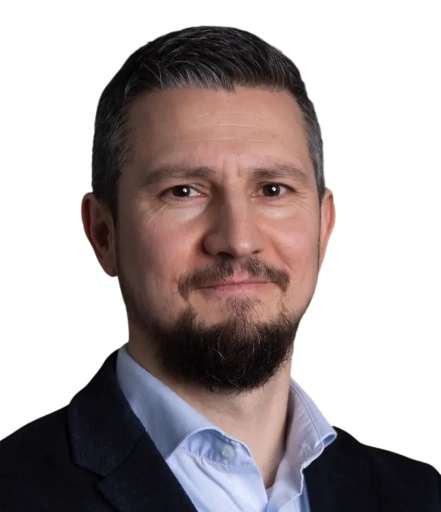
Last position:
Power BI Expert at MID-SIZED TRADING COMPANY FOR CLEANING TECHNOLOGY AND HYGIENE PRODUCTS
Reporting and controlling using Power BI for a production ERP system
- Analysis of ERP data and interfaces for use in Power BI dashboards
- Evaluation and migration of existing reports (e.g. Excel) to Power BI
- Development of an authorization concept for selective data access
- Documentation and training on the use and customization of Power BI dashboards
Label: Power BI, Excel, SelectLine ERP, Microsoft SQL, SQL Server Management Studio
Ornel Franck W.

Last position:
Sales Partner at ERGO PRO
- Industry: Insurance, Trade, IT
- Customers & Projects: Consulting and selling insurance and similar services
- Main tasks: Insurance consulting (health insurance, retirement planning, wealth building); commercial services, inside and field sales; sales data analysis and forecasting; customer consulting and support; opening a new sales headquarters for private and business customers; business development & innovation management; business use case development; process optimization; stakeholder management; team leadership and training; preparation and delivery of trainings;
- Technologies used: Microsoft Office 365, Microsoft Teams, Jira, Draw.IO, Camunda 8, Java (8, 17,21,25), Git, Spring Boot, Spring Batch, Spring Data REST, Spring Web, Spring Security, J-Unit, Playwright, Lombock, Vaadin, H2, PostgreSQL (16, 17 18), pgAdmin, Docker, LLMs, JasperSoft Studio, JasperReports
Christoph H.

Last position:
Project Manager & Test Manager at Cyber Security
SAP S/4HANA upgrade from Release 2021 to 2025 and FI/CO transformation as part of a new TOM. Four streams and two SAP service providers; management during ongoing operations.
Overall responsibility for time, quality and budget as well as cross-stream coordination of the four streams
Coordination of process streams, business functions and SAP service providers
Establishment and management of governance, planning, risks, dependencies, resources and escalations
Provider management, regular management reporting, and preparation and execution of project and Steering Committee meetings
Responsibility as Test Manager for test strategy, test planning, UAT, defect management and acceptance
Result: Successful preparation for Go-live on 28.09.2026 during ongoing operations; quality and the planned absence of production interruptions ensured. Project governance established and positive feedback from management and stakeholders.
Wolfgang O.

Last position:
Project Manager at EnBW - Netze Südwest
- New development and further development of the existing MS Dynamics CRM
IT systems: Microsoft Dynamics Customer Service, SharePoint, DevOps, SAP IS-U
- CRM implementation / further development
- Taking over from the previous service provider
- Business process analysis
- Agile project organization
- Business analysis / requirements engineering with AI support
- Use of AI in development
- Analysis of master data processes
- CRM customer data management
- Requirements documentation
- Stakeholder management
- Workshop moderation
Khalid E.

Last position:
Lead Architect & Developer at kem-consulting
Development of an agent-based governance platform for the automated assurance of EU AI Act compliance and ODA-compliant orchestration of AI services in complex enterprise environments.
Design and implementation of an agent-based "Mission Control" framework (Aletheia Conductor) for autonomous state monitoring and process control.
Development of "Compliance-as-Code" (CaC) solutions based on OPA/Rego for system-wide enforcement of regulatory guardrails.
Integration of TM Forum ODA standards (TMF630, TMF622, TMF642) to ensure interoperability and standardization.
Building a highly available event-driven architecture using Redpanda and CloudEvents v1.0 for near-real-time event processing.
Implementation of an audit-proof "Evidence Chain" through cryptographic linking of trace logs in preparation for automated audits.
Tech Stack: Java 21 (Quarkus Native), TypeScript (Next.js), Redpanda (Kafka API), CloudEvents v1.0, OPA (Open Policy Agent) & Rego, TimescaleDB, ZincSearch, Redis, TM Forum ODA, Git, GitHub, Clean Code Development, Like-C4.
Stefan O.

Last position:
Founder at ProtocolEngine.io
Evidence-led health intelligence platform turning published research into personal health protocols. It scores 430 habits, foods, and supplements against the studies behind them, and moves the score when the evidence moves. Built solo.
- Built the daily ingestion pipeline across PubMed, bioRxiv, and medRxiv: 43,000+ papers from 3,400+ journals processed into 230,000+ typed evidence claims, each one traceable back to the study it came from.
- Designed the six-factor evidence scoring model and the public changelog behind it, so no recommendation ever appears without the papers underneath it. 23,000+ grade changes recorded and explained to date.
- Shipped an entity information model connecting every intervention to its mechanisms, biomarkers, and outcomes: 118 biomarkers with region-specific reference ranges, 77 mechanisms, 32 graded outcomes.
- Built the personalisation layer: blood panel ingestion that reads lab PDFs with a vision model and corrects results for draw time against the user's wake anchor, plus Oura, WHOOP, and Withings integration for daily readiness context.
- Operate eleven specialised review agents over the corpus and codebase, covering paper curation, retrieval quality, health-claim compliance across EU and US regimes, and security.
- Shipped the Evidence Assistant, a RAG assistant that answers from the claim database and cites the underlying papers, plus a B2B practitioner tier, an Expo React Native app, and localisation across 3 languages and 7 markets.
Stack: Next.js 16, TypeScript, Supabase, pgvector, Anthropic Claude, Vercel, DeepInfra.
Kiriakos K.

Last position:
Tech Lead / Architect : OTTO API Platform at OTTO
Maturing their API practices on both a business and technology level. My role covers strategy, architecture, developer advocacy as well as hands-on software engineering, enabling both technical teams and business leadership to adopt and act on API-centric principles effectively. Coincidentally, we also establish GitOps, DX and platform best practices with this project.
Highlights:
- Aligning executives with the initiative by clarifying strategy, replacing misconceptions and myths with facts, clarifying the value of existing assets and enabling informed decision-making
- Formulating a way forward for API Lifecycle Management at OTTO
- Driving platform progress and fostering developer engagement by hands-on engineering work towards strategic goals
API Lifecycle Management, Team Topologies, Organizational Evolution, Regulatory, Platform Advocate, Developer Platform, Communities of Practice, Terraform, Kotlin, Kafka, Kong, WSO2, Apigee, Gravitee, Backstage, AsyncAPI, OpenAPI, API Design, AWS, React, Node.js, TypeScript, Redocly, reactive programming, CDC, Golang, Gin, GitOps, DX (developer experience), stakeholder management, roadmaps, workshops, discovery.
Discover over 15,000 top freelancers


Statistics of experts using Linux
Aggregated from the professional profiles of matched freelancers.

Experience
21 years

Position duration
5.2 years

Positions per freelancer
14

Top business areas
Information Technology, Product Development, Project Management

Top industries
Information Technology, Manufacturing, Banking and Finance

Certification focus areas
Information Technology, Project Management, Product Development

Bachelor's degree or higher
87%

Master's degree or higher
56%

Doctorate
11%

Certifications per freelancer
3

Most common languages
German, English, French

Speak two or more languages
98%
Based on our profile pool as of 9 Oct 2026.
Daily rate distribution
The chart shows how the daily rates of experts in this technology in Germany are distributed, based on recent contracts on our platform. Each bar covers a rate range — its height shows the share of experts charging within that range.
Discover detailed Linux rate benchmarks:
Explore rate insightsAverage rates of experts in Germany using Linux
Rates are based on recent contracts and do not include FRATCH margin.

The average daily rate is the mean of all daily rates from recent contracts of comparable freelancers on our platform.
The median daily rate is the middle value of all daily rates — half of comparable freelancers charge less, half charge more. Unlike the average, it is barely affected by outliers.
Calculated based on our freelancers’ daily rates as of 9 Oct 2026. Actual rates may vary depending on seniority level, experience, skill specialization, project complexity, and engagement length.
Linux experts industry focus
See which industries our matched freelancers work in most often — every figure is calculated live from the freelancers on FRATCH.
- Information Technology (90%)
- Manufacturing (44%)
- Banking and Finance (44%)
- Automotive (42%)
- Telecommunication (35%)
- Professional Services (35%)
- Healthcare (32%)
- Government and Administration (30%)
Please note that freelancers can work across multiple industries, so percentages overlap.
About the technology
Linux foundations
Linux is an open-source operating system kernel used in distributions such as Ubuntu, Debian, Red Hat Enterprise Linux and SUSE Linux Enterprise. Together with GNU tools, shells and system libraries, it supports servers, workstations, containers, appliances and embedded devices. Companies choose it for control, flexibility and dependable operation.
Systems and workloads
Linux runs the core systems behind web applications, APIs, databases, data platforms and high-volume network services. It also powers Kubernetes nodes, virtual machines, edge gateways and industrial devices. In Germany, specialists often support manufacturing, logistics, financial services and research environments where stable operations and clear access controls matter.
- Provision and harden Linux servers
- Operate web, application and database environments
- Support container and Kubernetes workloads
- Maintain embedded and edge systems
Tools and ecosystem
Strong Linux expertise reaches beyond command-line administration. It includes Bash or Python scripting, systemd, SSH, package management, Git, Ansible, Terraform, Docker and Kubernetes. Depending on the distribution, professionals work with APT, DNF or Zypper and understand networking, storage, identity services, logging and monitoring.
When specialists help
Freelance expertise is valuable during cloud migrations, distribution changes, security remediation and production incidents. Companies also bring in specialists when internal teams need a repeatable server baseline, infrastructure as code or support for a new container platform. Remote work is common, while on-site collaboration can help with data centers, laboratories and industrial equipment in Germany.
- Replace manual server setup with automation
- Diagnose performance, networking or storage issues
- Establish patching, backup and recovery processes
- Prepare systems for audits and production handover
What quality looks like
A strong professional explains operational trade-offs instead of applying generic commands. They document changes, test recovery paths and separate development, staging and production access. They understand least privilege, secure SSH configuration, firewall rules, certificates, backups and observability, while keeping the chosen distribution and business constraints in view.
Choosing the right fit
Match the specialist to the workload, not just the operating system label. A cloud migration needs experience with networking, identity and infrastructure automation; an embedded project may need kernel configuration, cross-compilation and hardware debugging. Ask for relevant delivery examples, clear incident habits and communication that suits your remote or on-site team and its language expectations.

Frequently asked questions
Not sure where to start with Linux? These answers cover the essentials.

Linux is used for web and application servers, databases, cloud infrastructure, containers, network services and embedded products. It is also common in research, manufacturing, logistics and financial systems where companies need configurable, stable infrastructure.
Linux offers an open ecosystem, broad automation options and many distribution choices. Windows Server may fit environments centered on Microsoft identity and application tooling, while commercial Unix systems often serve established enterprise workloads; the right choice depends on software compatibility, support needs and internal skills.
A capable Linux specialist often works with networking, storage, security, Bash, Python, Git, Ansible, Terraform, Docker and Kubernetes. Cloud services, monitoring, databases and identity management are also valuable when the work covers complete production environments.
The need depends on the risk and scope of the work. A routine server configuration may suit a general Linux professional, while kernel work, large migrations, regulated systems or major incidents call for someone who has handled comparable production conditions.
Linux operations are often well suited to remote collaboration through secure access, documentation and change control. On-site presence may still matter for data centers, hardware, industrial networks or systems that cannot be reached remotely; agree on access, availability and German or English communication at the start.
Ask how the Linux specialist approaches hardening, backups, monitoring, incident response and rollback. Look for precise documentation, sensible automation, tested recovery procedures and explanations that connect technical choices to uptime, security and business impact.
GNU/Linux commonly describes a complete operating system made from the Linux kernel, GNU tools and other open-source components. In everyday business language, Linux usually refers to the full distribution, such as Ubuntu, Debian or Red Hat Enterprise Linux.
A Linux professional should clarify the distribution, hosting model, access rules, service dependencies and ownership of documentation before changing systems. Reliable delivery includes tested automation, a rollback path, handover notes and clear communication about operational risks.
The average hourly rate of freelancers in Germany who have used Linux in their recent projects is 96 €, which corresponds to a daily rate of about 766 € based on an 8-hour working day.
Of the freelancers in Germany who have used Linux in their recent projects, 87% hold at least a Bachelor's degree, 56% hold at least a Master's degree, and 11% hold a doctorate.
On average, freelancers in Germany who have used Linux in their recent projects have 21 years of professional experience, with a single engagement typically lasting around 5.2 years.
The most common languages among freelancers in Germany who have used Linux in their recent projects are German (98%), English (97%), and French (20%).
The most common industries among freelancers in Germany who have used Linux in their recent projects are Information Technology (90%), Manufacturing (44%), and Banking and Finance (44%).
The most common business areas among freelancers in Germany who have used Linux in their recent projects are Information Technology (96%), Product Development (77%), and Project Management (60%).
Main locations of FRATCH Experts, who have recently used Linux
Our freelancers and interim experts are at home across the DACH region — available on-site in the major business hubs or fully remote. Choose a location to discover matched specialists, local market insights and up-to-date availability.

 Berlin
  Hamburg
  Munich
  Cologne
  Frankfurt
  Stuttgart
  Dusseldorf
  Leipzig
  Dortmund
  Essen
Essen  Bremen
  Dresden
  Hanover
  Nuremberg
 Request a free demo
Get in touch with the FRATCH team and we will get back to you within 4 hours.
Would you rather directly get in touch?
We always have the time for a call or email!

Philipp Thomaschewski
FRATCH CEO

