


IS-IS Experts in Germany
in minutes from over 15,000 CVs with vetted, available specialists.Hire experts who design, tune, and troubleshoot IS-IS for backbone routing, multi-area designs, and traffic engineering across carrier and enterprise networks. Get fast, precise matching with vetted, available freelancers.

Meet FRATCH Experts in Germany, who have recently used IS-IS
Valentin O.
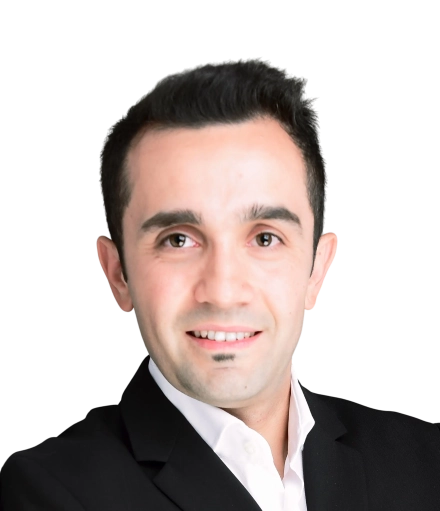
Last position:
Network Architect at IT Service Provider - Public Sector
- Designed a network management strategy focused on NetDevOps principles and model-driven telemetry using YANG data models
- Conducted NETCONF/YANG workshops for L2VPN/L3VPN services over SRv6
- Automated configuration deployment in the testing environment with Ansible
- Developed end-to-end service measurement concepts with IPSLA and the Telegraf-Prometheus-Grafana stack
- Created the dual-stack architecture design (router + switch + firewall) including a detailed test plan; planned, executed, and documented acceptance tests for the management network
- Performed BSI IT baseline protection checks according to the IT-Grundschutz catalog (needs assessment, modeling, risk analysis, deriving measures)
- Protocols: SRv6, IPv6, MPLS, BGP, ISIS, OSPF, NETCONF/YANG, model-driven telemetry, IPSLA
- Systems: Cisco Crosswork Network Controller, SolarWinds Orion, Grafana, InfluxDB, Telegraf, Ansible, Git
- Components: Cisco NCS router series, Cisco Catalyst switch series, Cisco Firepower firewall series
Mustafa K.
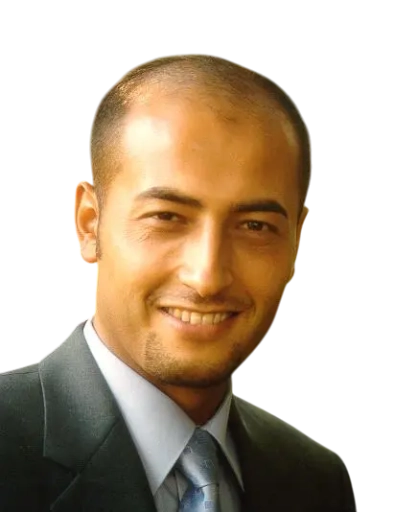
Last position:
Senior Network Design and Engineer at Helaba
Designed and specified the technical network integration of a new business-critical application system (MUREX) in the capital markets area in a complex interface and outsourcing environment.
Created component specifications, a catalog of measures and an implementation plan.
Ensured proper integration of the developed results in line with the bank’s framework: IT compliance, IT security, change and release management.
Selected and integrated a new service provider for the bank; moved critical bank applications to the provider.
Designed, implemented and supported the new Cisco network and Fortinet security setup at the service provider data center.
Acted as technical interface between the bank, service providers and consulting partners.
Supported and further developed the network and security infrastructure (clients, servers, networks); performed error analysis and implemented solutions within agreed service levels.
Analyzed and diagnosed all security and network failures, glitches and malfunctions.
Initiated continuous improvements to ensure efficient resource use and acceptable response times for users.
Provided network support in a financial services organization and prepared operational changes on production banking network infrastructure for both large and small projects within strict change management discipline.
Designed, defined, tested, governed and improved engineering standards.
Performed the role of network architect for medium to large projects involving team resources.
Charles J.

Last position:
Network Architect at RedGlobal GmbH
- Configuration of Dell switches, routers, and access points.
- Troubleshooting and issue resolution.
- Extreme, Cisco and Dell switches and routers environment, Extreme A3 NAC, Extreme CloudIQ.
Oumarou B.

Last position:
WAN & Data Center Network Administrator at Teamative Germany GmbH
- Implementation, administration, configuration and operation of Cisco network components (PE-CE routers, provider routers, SD-WAN, switches, access gateways)
- Ensuring the availability, performance, further development and operation of the network infrastructure of the state access network WAN
- Creation of technical documentation in FNT-Command
- Troubleshooting and handling of incidents, changes, requests and problems tickets
- Tools: ITSM, Command-FNT, Orion, ASDM, Panorama
- Scripting: Bash Shell, Python, Ansible
- Protocols: IS-IS, BGP, MPLS, VRF, GETVPN, Segment-Routing, Static routing
- Devices: NCS-57C3 Series, ASR-1000 Series, ISR-4331, ISR-4451 SD-WAN, Catalyst 9k Series, Nexus 9k Series
- Firewall: Check Point, Palo Alto, Cisco ASA-5585, FWSM
Andreas W.

Last position:
Freelancer at Infrafibre Networks GmbH
- Assessing the current status (planning stage / rollout status) of the so-called inter-polygon routes
- Creating an end-to-end project plan for the individual routes, considering active and passive components and tasks
- Monitoring and controlling the implementation of the plan
- Optimizing the chosen network architecture
- Creating network and splice diagrams
Khyser M.
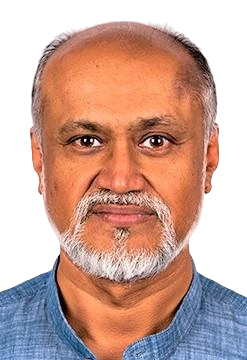
Last position:
Life Cycle Infrastructure Network Analyst at Hays AG
- On-site implementation and upgrade of the life cycle infrastructure for a global partner of a Hays customer.
- On-site implementation for international locations in APAC & AMER.
- Executed on-site life cycle infrastructure upgrades for sites IN-NDA, IN-MOX, US-CAX, US-MOT, CN-YAN, and IN-MOR according to customer requirements. This included project management, administration, network design, optimization, as well as planning and deploying redundant OM4 and OS2 fiber and redundant power systems.
- Designed, upgraded, and migrated data centers for the above sites, including international on-site travel to the USA and India.
- Led and oversaw the network team, providing remote and on-site support for cabling work.
- Created network documentation, including L2 and L3 Visio drawings, IP address planning, network patch plans, power plans, bayface layouts, access point layouts, ISP carrier layouts, data center planning, downtime planning and scheduling, hardware checklists, network device configuration, implementation, test plans, and proposal evaluations.
- Extensive experience with Cisco hardware, including switches (9200, 9300, 9400, 4500, 3850, and 2960 series), WLC (9800, 5505, 3504, and 2800 series APs), ASA (55xx series), and NG Firepower (1010, 1120).
- Maintained documentation, including NetBox, PRTG monitoring, RADIUS, DNS, DHCP, and KX handover sessions, troubleshooting & trainings.
- Life Cycle Technical Guide & Control
Konstantinos M.

Last position:
IT System Engineer at Client belongs to critical infrastructure
- IT infrastructure services
- IT services, networks, Exchange, Office 365 & 2016
- IT documentation
- Collaboration with external partner & managed provider
- Stakeholder management
Discover over 15,000 top freelancers


Statistics of experts using IS-IS
Aggregated from the professional profiles of matched freelancers.

Experience
26 years

Position duration
2.4 years

Positions per freelancer
14

Top business areas
Information Technology, Operations, Project Management

Top industries
Information Technology, Telecommunication, Banking and Finance

Certification focus areas
Information Technology, Project Management, Accounting

Bachelor's degree or higher
60%

Master's degree or higher
20%

Certifications per freelancer
6

Most common languages
German, English, Greek

Speak two or more languages
100%
Based on our profile pool as of 9 Oct 2026.
Daily rate distribution
The chart shows how the daily rates of experts in this technology in Germany are distributed, based on recent contracts on our platform. Each bar covers a rate range — its height shows the share of experts charging within that range.
Average rates of experts in Germany using IS-IS
Rates are based on recent contracts and do not include FRATCH margin.

The average daily rate is the mean of all daily rates from recent contracts of comparable freelancers on our platform.
The median daily rate is the middle value of all daily rates — half of comparable freelancers charge less, half charge more. Unlike the average, it is barely affected by outliers.
Calculated based on our freelancers’ daily rates as of 9 Oct 2026. Actual rates may vary depending on seniority level, experience, skill specialization, project complexity, and engagement length.
IS-IS experts industry focus
See which industries our matched freelancers work in most often — every figure is calculated live from the freelancers on FRATCH.
- Information Technology (86%)
- Telecommunication (71%)
- Banking and Finance (43%)
- Automotive (29%)
- Energy (29%)
- Manufacturing (29%)
- Professional Services (29%)
- Government and Administration (29%)
Please note that freelancers can work across multiple industries, so percentages overlap.
About the technology
Routing Core
IS-IS, short for Intermediate System to Intermediate System, is a link-state routing protocol used to move traffic across large Layer 3 networks. It is common in service provider backbones and in enterprise cores that need stable, scalable routing with clear area design. Strong experts know how to keep adjacency, SPF behavior, and route propagation predictable.
Typical Work
- Design Level 1, Level 2, and multi-area routing
- Build backbone and edge routing for MPLS and IP networks
- Tune metrics, summarization, and route preference
- Troubleshoot adjacencies, flaps, and convergence issues
- Prepare migration plans from OSPF or older designs
Tooling And Standards
Work usually spans Cisco IOS and IOS XE, Juniper Junos, Nokia SR OS, and other carrier-grade stacks. Experts also deal with BFD, MPLS, IPv6, traffic engineering, and route policies around IS-IS. They should read packet captures, review SPF timing, and validate topology changes before rollout.
When To Bring In Help
Companies often bring in freelance IS-IS specialists during backbone changes, incident recovery, audits, or platform migrations. In Germany, this is common when teams need short-term support for cross-site networks, carrier handoffs, or multilingual documentation that must stay precise. Remote work fits design and troubleshooting well, while on-site time helps during cutovers.
What Good Looks Like
Strong professionals do more than configure neighbors. They understand topology, failure domains, and how IS-IS behaves under load or during partial outages.
- Clear network design and clean area boundaries
- Practical troubleshooting across control plane and data plane
- Safe change plans with rollback steps
- Familiarity with vendor differences and route policy details
Related Skills
IS-IS work often sits next to MPLS, IPv6, BGP, BFD, QoS, and automation with Ansible or similar tooling. The best specialists can explain why a route is preferred, how an LSP change affects the network, and where to place filters without breaking reachability. That mix matters when the network must stay stable during growth or migration.

Frequently asked questions
Everything clients usually want to know about IS-IS, in one place.

IS-IS is used for internal routing in large IP networks, especially backbones that need stable convergence and clean hierarchy. It carries reachability between routers and helps operators control how traffic moves through the core. You will most often see it in service provider networks and large enterprise cores.
IS-IS is not universally better; it is a different fit. Teams often choose it for large, well-structured core networks because the protocol scales cleanly and keeps the design simple at the area level. OSPF is also common, so the right choice depends on the existing network, vendor stack, and operating model.
A strong IS-IS specialist usually understands BGP, MPLS, IPv6, BFD, and route policy. Those skills matter because IS-IS rarely lives alone in a modern backbone. Experience with Cisco, Juniper, or Nokia platforms is also valuable when the network spans multiple vendors.
A IS-IS project can be simple if it is a small lab or a limited change, but production backbones need proven hands. The right specialist should have handled adjacency issues, area design, and safe migration work before. For cutovers or incident recovery, practical network operations experience matters more than theory.
Yes, much of IS-IS design, troubleshooting, and documentation can be done remotely if the team has good access to the network and clear change control. On-site support can help during hardware swaps, major cutovers, or when hands-on coordination is needed. In Germany, many teams combine remote planning with short on-site sessions.
Look for clear explanations of areas, metrics, SPF behavior, and failure handling in IS-IS. Good specialists can describe how they would prevent route leaks, reduce flap impact, and validate a change before rollout. They should also be comfortable reading logs, topology outputs, and packet captures.
IS-IS is the common name people use today, while ISO IS-IS refers to its original ISO network layer roots. In practice, most hiring conversations mean the IP routing protocol used in modern networks. If a candidate can explain both the history and the current deployment model, that is usually a good sign.
IS-IS is most common in carrier networks, large backbones, and some enterprise cores. Location matters when you need on-site support for cutovers, hardware work, or close coordination with local teams, but many design and troubleshooting tasks can be handled remotely. For Germany-based projects, clear communication and exact documentation are especially useful.
The average hourly rate of freelancers in Germany who have used IS-IS in their recent projects is 99 €, which corresponds to a daily rate of about 790 € based on an 8-hour working day.
Of the freelancers in Germany who have used IS-IS in their recent projects, 60% hold at least a Bachelor's degree and 20% hold at least a Master's degree.
On average, freelancers in Germany who have used IS-IS in their recent projects have 26 years of professional experience, with a single engagement typically lasting around 2.4 years.
The most common languages among freelancers in Germany who have used IS-IS in their recent projects are German (100%), English (100%), and Greek (14%).
The most common industries among freelancers in Germany who have used IS-IS in their recent projects are Information Technology (86%), Telecommunication (71%), and Banking and Finance (43%).
The most common business areas among freelancers in Germany who have used IS-IS in their recent projects are Information Technology (100%), Operations (100%), and Project Management (71%).
Main locations of FRATCH Experts, who have recently used IS-IS
Our freelancers and interim experts are at home across the DACH region — available on-site in the major business hubs or fully remote. Choose a location to discover matched specialists, local market insights and up-to-date availability.
 Berlin Hamburg Munich Cologne Frankfurt Stuttgart Dusseldorf Leipzig Dortmund Essen Bremen Dresden Hanover Nuremberg
 Request a free demo
Get in touch with the FRATCH team and we will get back to you within 4 hours.
Would you rather directly get in touch?
We always have the time for a call or email!

Philipp Thomaschewski
FRATCH CEO

